Showing posts with label fruit. Show all posts

Thursday, 16 June 2011

Blackberries 2011 - In June!

Blackberries June 2011
Incredible as it may seem, quite a few of the blackberry bushes are fruiting. The first couple that we tried were not very nice, but then we came across this larger patch in a south facing field.  Let's just say that it was just as well that we took the photo before we started eating them as there weren't any left afterwards. 

We'll be keeping a close eye on this patch as there were lots of unripe fruit, so with a bit of rain (please) and sun we may get a good crop.

Nonetheless, it is strange to have fruit on some plants when the majority are yet to flower. I presume that this has been caused by the weather, with some plants taking advantage of the hot and dry conditions to fruit while others have been held back by the lack of water and the intense heat.
Blackberries June 2011


Monday, 9 May 2011

Food for Free – Wild Strawberries

Cultivated Strawberries Versus Wild Strawberries

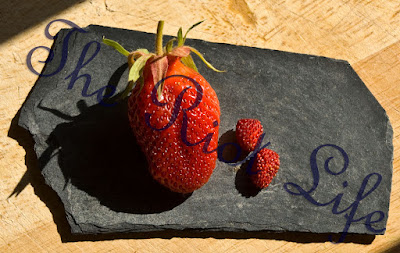
Wild and cultivated strawberries on slate
Tesco and Sainsbury’s may be selling more English strawberries this year, but you can’t beat our wild strawberries with no food miles and only seconds between picking and eating.In our wood we have just harvested our first wild strawberries of the year. As you can see from the photograph these wonderful little fruits are a fraction of the size of their cultivated brothers but their taste more than makes up for their petite size.

Foraging for Wild Strawberries

Gathering wild strawberries requires patience and a keen eye. These tiny fruits measuring less than a centimetre in length can be very difficult to find as they nestle amongst the leaves and undergrowth on the woodland floor, but the flavour hit they give means that they are worth looking for. The best time to forage for these glorious wild strawberries is in the middle of the afternoon, when the sun is still high giving as much light as possible into the wood which makes it easier to spot the fruits. Also, the wild strawberries seem to taste better if they have been warmed by the sun.

Wild strawberry flower
As you walk amongst the trees you can identify the wild strawberries by their trefoil leaf, the flowers, and of course the pinpoints of bright red. Both the leaves and the flowers look almost identical in shape and colour to a cultivated strawberry just smaller. Once you have found one strawberry look closely and you will find many more as they are often found in groups.  Be sure to look above and below the leaves for the tiny fruits.  When you have found your ripe wild strawberries, gently pick it from the plant, taking care not to pull the tiny plant from the ground.

How to Eat Wild Strawberries

The Collins Gem Food for Free book suggests adding wild strawberries to a glass of champagne, but for me I don’t think you can beat placing a freshly picked wild strawberry that is still warm from the afternoon sun on the tongue, closing your eyes and then squashing it against the roof of the mouth. The fleeting feeling in your mouth as the soft ripe strawberry bursts followed by the flavour erupting is truly sublime and one to savour.

Wild strawberry with flower and fruit
Transplanted Wild Strawberries

I love the taste sensation of wild strawberries so much that earlier this year I transplanted some from our wood into a border and strawberry planter close to the house.  It is fascinating seeing close-up how plants grow and develop differently depending on where they are.  With the strawberries that I have transplanted I have a lot more strawberries per plant however they are smaller and not ready to eat yet. I think it may have something to do with the lack of rain this year as whilst I have watered them in the evenings the soil is drying out in the day unlike that in the woods where the canopy of the oak, chestnut and cherry shelters them from the midday sun.

Friday, 6 May 2011

Nettle Fertiliser

Nettle fertiliser
Our aim with our old farm is to manage it both ecologically and economically.  The problem is that our soil here is fairly inorganic, with a layer of limestone overlaying a layer of clay, so getting fruit and vegetables to grow strongly is a challenge.  We are creating lots of compost to add in future years which should make the soil a lot better, but in the meantime we are making our own organic fertiliser.

To make this, you need to collect a wheelbarrow load of nettles (and don't worry if you get other plants, they won't harm).  Apparently, young nettles are better, but we've not been using the nettle fertiliser enough to know how much difference the age makes.  Then, you need to scrunch them up to damage the leaves and stalks, although they seem to rot down quite well without too much damage. 
Nettle fertiliser and compost bins nestled amongst the lilacs

Put the nettles in a container that has a lid, and then add water to cover them.  Make sure that the container is well away from your house or anywhere that you want to sit, because after 2 - 4 weeks it will stink like pig manure.  This is the sign that it is ready for use, but you don't want anyone with a weak stomach to help you.

Take off the amount of fertiliser that you need for an application, then refill the container with fresh nettles and more water.  I leave the old nettles in so that they keep rotting down, but others take theirs out and put them on the compost bin.

You need about 1 litre of nettle fertiliser for about 10 litres of water to make sure that the plants are not over fertilised.  We apply this every 2 - 3 weeks to replace one of our normal waterings.  We don't know for certain that the nettle fertiliser is working as we don't have a control patch, but after an application the plants do seem to put on a growth spurt.

The main element in nettle fertiliser is Nitrogen, which feeds leaf and stem growth.  Its use should be scaled back as the fruits start to develop and it should be replaced with a Potassium rich fertiliser.  We are hoping that the ash from our wood fire will provide this, along with the odd banana skin.

First Strawberries

First Strawberries of 2011 from our organic vegetable patch

Just been outside to our organic fruit and vegetable patch to pick our first strawberries of the year.  We are looking forward to having them later this morning with our breakfast.